13. 1. 2022
Salary Rates in the Czech Republic in 2022
Legislation regarding wages is usually amended at the beginning of the new year. Since 2015 the minimum wage has been regularly increased every year. 2022 is no exception. Below is a basic overview of the minimum, guaranteed and average salary rates for 2022.
Minimum Salary
The minimum monthly salary for 2022 is CZK 16,200 (i.e. approx. EUR 650) and the minimum hourly rate for 2022 is CZK 96.40 (i.e. approx. EUR 3.90). This applies to all jobs with agreed working hours of 40 hours per week, i.e. full-time work. If a shorter working time has been agreed, the minimum salary is reduced proportionately. Compared to 2021, this is an increase in the minimum salary by CZK 1,000 (approx. 6.6 %), while the inflation rate reached only 6.0 % in November 2021.
In case the gross salary, after deduction of:
overtime pay,
additional payment for work on Saturdays and Sundays or public holidays, night work or work in a difficult working environment (“Extra Payment”), does not reach the minimum salary, the employer is obliged to provide the employee with a supplement to the salary.
Guaranteed Salary
Levels of the guaranteed salary for 2022 were also increased. The amount of the guaranteed salary depends on the complexity of the work, the responsibility of the employee for the work performed and the severity of the work. For the purpose of determining the guaranteed salary, eight categories of work are distinguished.
The current level of guaranteed salaries for full-time work are:
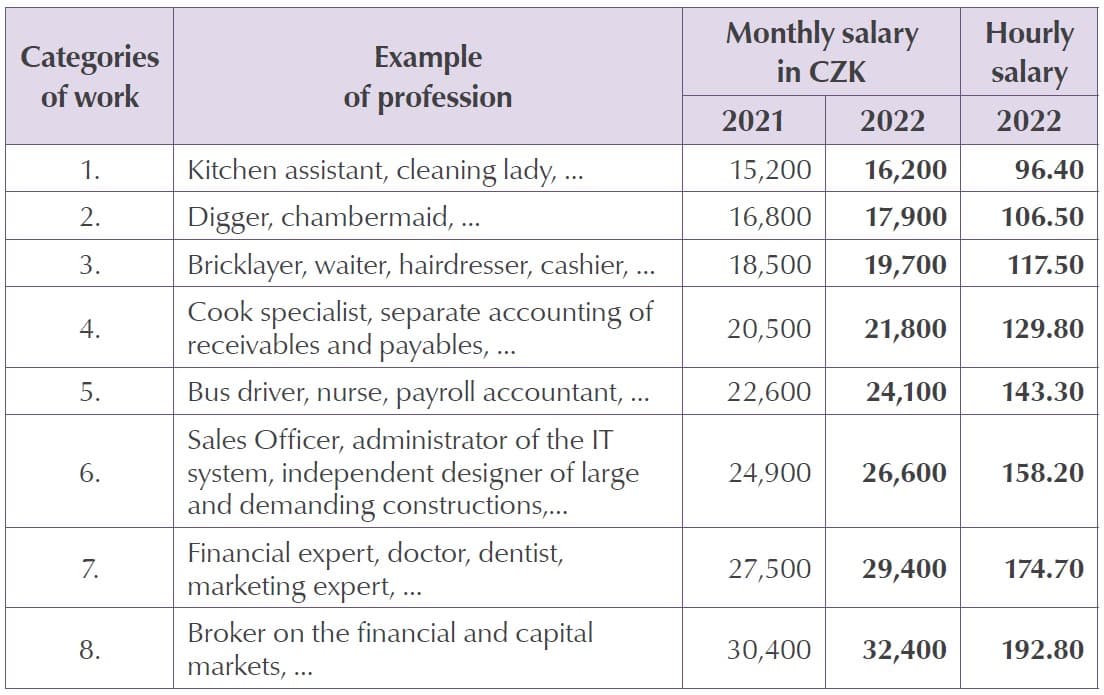
The employer is obliged to provide employees with a supplement to the salary if, after deduction of the Extra Payment, the appropriate level of guaranteed salary is not reached.
Average Salary
There was also an increase in the average salary for 2022, which amounts to CZK 38,911 (i.e. approx. EUR 1,570).
Amendment of Existing Contracts
If the employee's salary was agreed in the employment contract in the amount of the minimum or guaranteed salary, we recommend to conclude an amendment to the employment contract, which will increase the salary accordingly and state the exact amount.
We would also like to draw attention to the fact that the increase in the minimum salary also affects agreements outside the employment relationship, such as agreement to perform work or an agreement on work activity. However, this does not apply to the guaranteed salary. If an hourly remuneration of less than CZK 96.40 has been agreed with an employee, we also recommend to conclude an amendment that will increase the remuneration to at least CZK 96.40 irrespective of the actual form of the agreement.
By Dagmar Junková
Download

G&P Newsletter 1/2022 (PDF)
Author

News & Publications

Another Success for Giese & Partner Before the European Court of Human Rights
The European Court of Human Rights has once again confirmed the arguments presented by Giese & Partner. In a recent case, the Czech Republic acknowledged a violation of the right to a fair trial, marking another successful outcome for attorney-at-law Ondřej Rathouský before the ECtHR.

From Ankara to Brno: Why the Constitutional Court Intervened Before Deciding the NATO Dispute
The Czech Constitutional Court’s interim measure secured the President’s participation in the NATO summit but left the underlying constitutional dispute unresolved. The case highlights the role of established constitutional practice when the written Constitution provides no clear answer and raises broader questions about the balance of power between the President and the Government.

Who Will Inherit Your Digital Life? Digital Estate Part One
What happens to online accounts, cloud-stored data and cryptocurrency after death? This introduction to the digital estate explains which assets may pass to heirs, why legal inheritance does not always mean practical access and what the German Facebook case reveals about digital inheritance.